For California high schools building the AB 2927 personal finance course
Commencement is a beginning.
Helping high schools give students the financial knowledge and skills to shape their own futures.
Many of us finished high school without a class on money. California now requires one. Here is a complete course, a college-planning program, and the classroom games that go with them, mapped to AB 2927 and free for schools to use.
The work
Two programs, and everything a teacher needs to run them.
Each piece stands on its own. Together they cover a semester of personal finance and the biggest financial decision most teenagers make.
The course
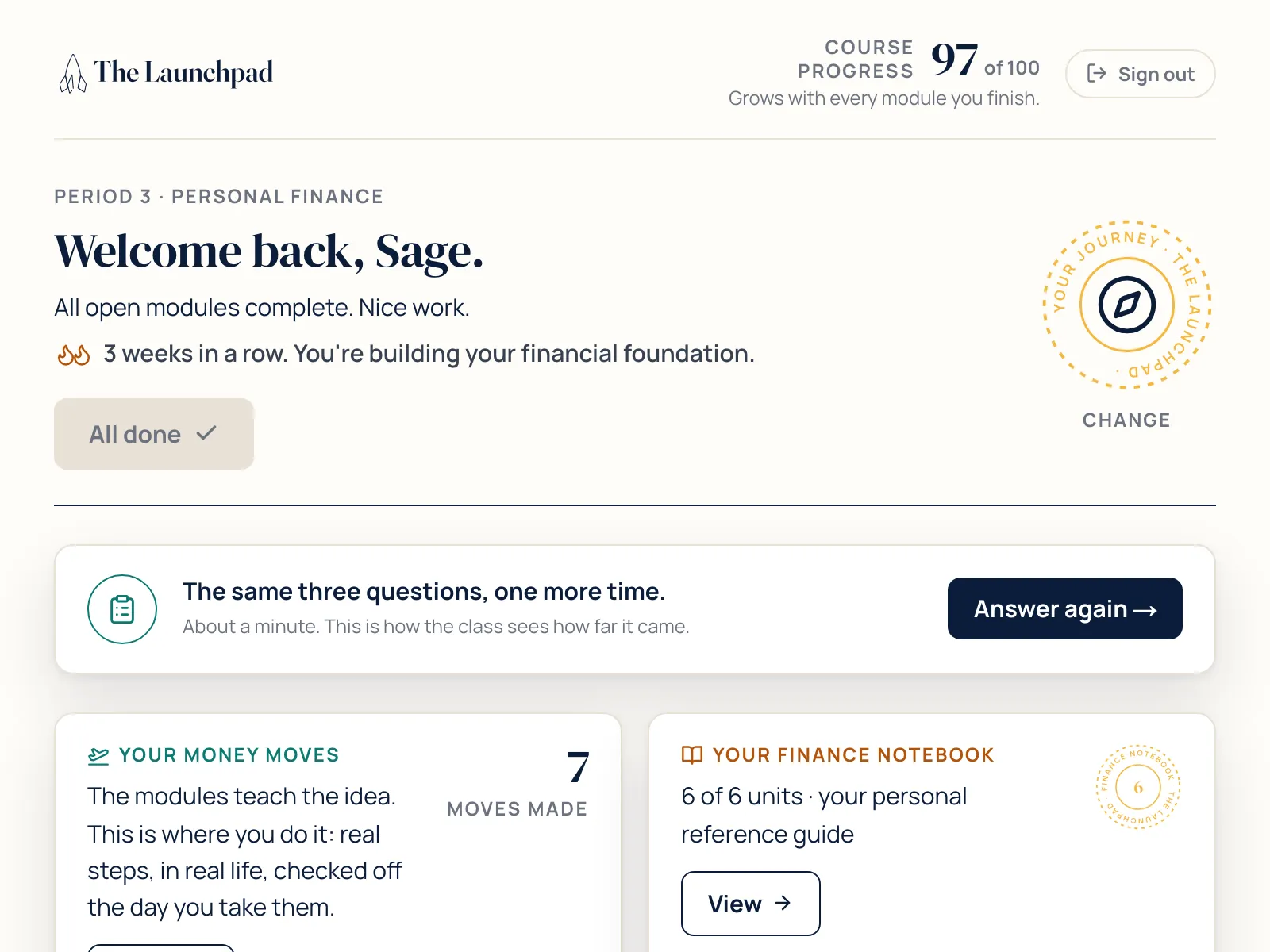
The Launchpad
A complete personal finance course, delivered as a web app.
Six units, from Banking & Saving to Insurance, with a playbook for every module and a live dashboard that shows understanding shift before and after. Students leave with Money Moves, the real steps they choose for themselves, and a Finance Notebook of what they learned in their own words.
The college-planning program
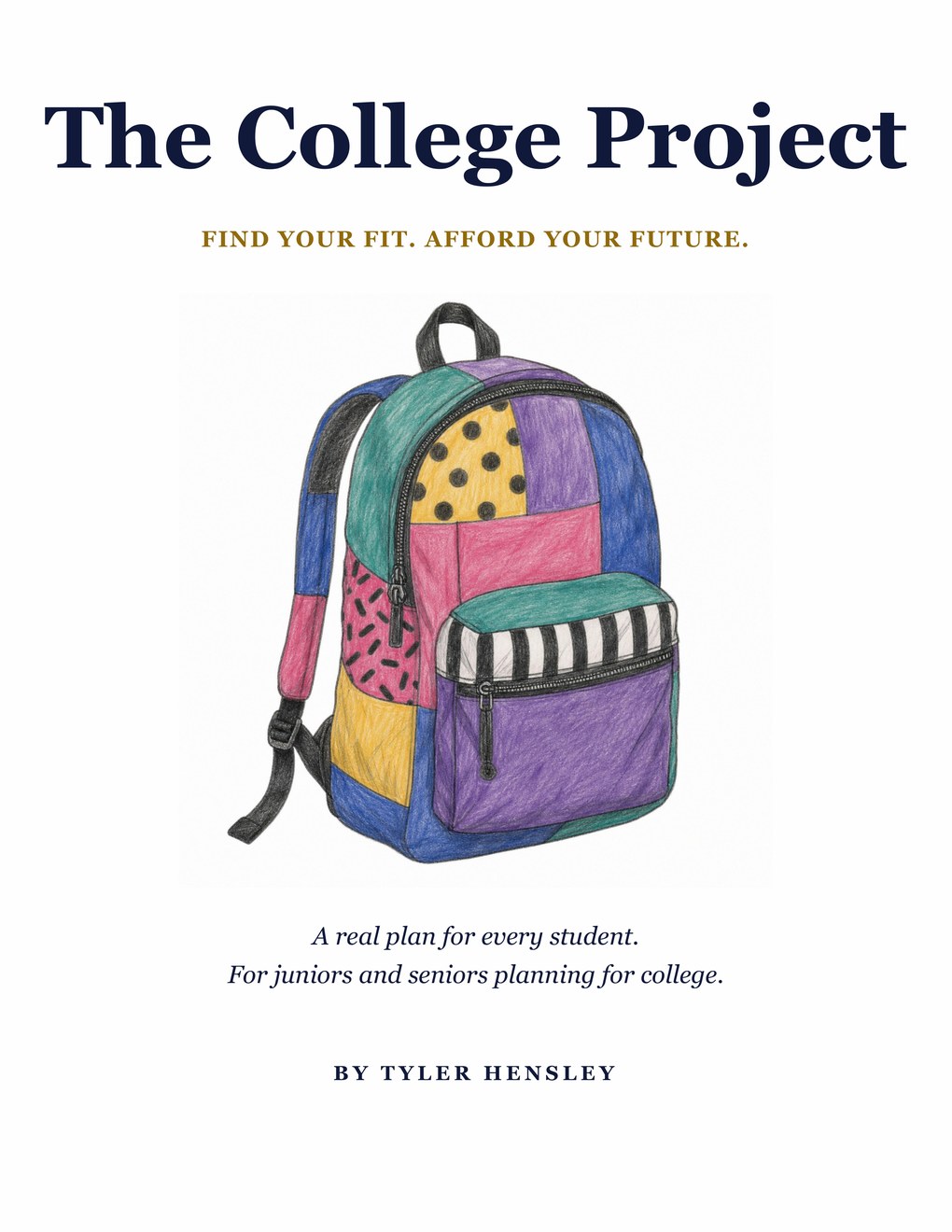
The College Project
The piece most personal finance courses miss: a personalized plan for life after high school.
Every student investigates who they are, compares every path after high school, and runs the real numbers, then builds a plan they can afford and adapt. With one counselor for every 443 California students, it puts the planning in each student's hands. A book, a one-period lesson, a Launchpad unit, checklists, and family calendars.
For any class, any day
Drop one in this week.
The Advisor Series
Students take the advisor's chair.
They read one real person's situation, decode the numbers, and write a committed recommendation built on data and judgment.
In print, with one case inside The LaunchpadReal Takes
Short, sharp warm-ups and closers.
One interactive, one big idea, and a discussion the class remembers. Assign one any day, with a print version and a projector mode.
Inside The Launchpad and in printDraft Day
Think like an investor, not a bettor.
Teams build a $50,000 portfolio over five rounds, write a thesis for every pick, and hold what they buy. No day trading, no leaderboard.
draftday.thelostunit.orgThe Arcade
Quick classroom games, no login.
College High/Low, Debt or Alive, Sticker Shock, and Good, Bad, or Depends? The teacher hosts and students join with a game code.
play.thelostunit.orgThe One Hour lesson
The College Project in a single period.
Students guess what five colleges really cost one student, see the real prices, then look up schools of their own. On paper, no devices.
onehour.thelostunit.orgThe Life Stage Calculator
Watch compounding do the heavy lifting.
See what investing at every stage of life adds up to. Pairs with the Life Stage Experiment, a printable lesson built on it.
calculator.thelostunit.orgIn print
For classrooms that work on paper. Proceeds currently go to The Finance Lab.
How schools start
Start with an hour. Grow into a course.
One class period
Run the One Hour lesson or host an Arcade game.
Free · paper or projector
A few weeks
Teach one Launchpad unit, or The College Project as a unit.
Free · class code, no student emails
A full semester
Run The Launchpad as your AB 2927 personal finance course.
Free · every topic mapped
What we measure
Outcomes, not outputs.
Most programs report how many students they reached. That's an output. The Launchpad measures what changed: what students learned, how their confidence moved, how they compare with adults nationally, and what they actually did with their money.
01
Knowledge
Every module asks matched questions before and after on the same concept, so a gain reflects learning, not a remembered answer.
02
Confidence
Students rate their confidence at the start and end of each module, which shows where a class was overconfident and where the gap closed.
03
A national benchmark
The Big Three financial literacy questions on the first and last day place a class against national results.
04
Action
Each student's Money Moves records real steps, like opening an account or filing the FAFSA, marked done the day they make them.
Teachers see every result on their dashboard and can download their class data anytime. Held in trust: The Finance Lab never sells student data, and a district can request its own data anytime.
How student data is handledEvidence
What changed for students.
368
students surveyed in The College Project's 2018 research cohort, at a Title I California high school
46.7%→83.3%
believed they could afford a 4-year public university
17.6%→69%
believed they could afford a 4-year private university
20 pts
drop in the share of students highly stressed about college costs
Pre-course and post-course surveys from The College Project (2018). These are belief and stress measures, not knowledge measures. The Launchpad measures knowledge directly: matched pre and post questions in every module, plus the Big Three financial literacy questions on the first and last day. Its first cohort is in classrooms now, in fall 2026.
Results published by The Finance Lab. See the evidence
“I hope more schools implement some part of this into their curriculum. It’s really important that students are educated on this early and regularly, not just their senior year with everything in the rear view.”
“I’ve used The College Project in my classroom for several years. My students found many of their questions answered in this comprehensive, insightful book.”
“Nobody in my family has gotten this far in education. These chapters made me realize that everyone has a chance to go to college regardless of their background.”
“For once we weren’t being left alone in the dark.”
AB 2927 rollout support
Your course starts in 2027–28. Your teachers start sooner.
Every California high school must offer a one-semester personal finance course starting in 2027–28, and the class of 2031 has to pass it to graduate. Many of the teachers assigned to it haven't taught personal finance before. Tyler helps districts, county offices, and charters get from the law to a course that runs well: the plan, the teachers, and the first semester.
Readiness Session
Assistant superintendents, principals, and counselors
Teacher Bootcamp
The teachers assigned the course
Year-One Coaching
The same teachers, during their first semester

Creator of The Launchpad and The College Project
Tyler Hensley
Tyler studied finance at USC and began his career in wealth management at UBS, where he held Series 7 and 66 licenses. He left to teach, and has spent 17 years in classrooms from Kosrae, Micronesia, to High Tech High and a Title I high school in Huntington Beach.
He wrote the first edition of The College Project in 2016 for AVID and Business Academy seniors at Ocean View High School. Since then he has built a personal finance elective that grew to four sections, designed his district's personal finance graduation requirement, and consulted for Stanford's Personal Finance Teacher Training Institute. He was a Stanford Hollyhock Fellow, holds an M.A. in Education, and founded The Finance Lab, a California nonprofit, in 2017.
- Award of Excellence, Roseville Joint Union High School District (2025)
- Hollyhock Fellow, Stanford University (2015 to 2017)
- National Innovative Educator of the Month, Visa (2012)
- Speaker: Stanford Equity in Education Conference, ASCD Empower, and the Financial Literacy and Economic Education Conference (2018)
 CommencementFinanceThe Finance Lab runs it. Tyler Hensley makes it.
How this works with The Finance Lab
Tyler creates The Launchpad, The College Project, and the Arcade and licenses them to The Finance Lab, a California 501(c)(3) he founded, for free. The Finance Lab runs them at no cost to schools and protects student data.
Commencement Finance is Tyler's own: licensing the works, class sets of the books, and paid rollout support. No school needs any of it to use The Launchpad.